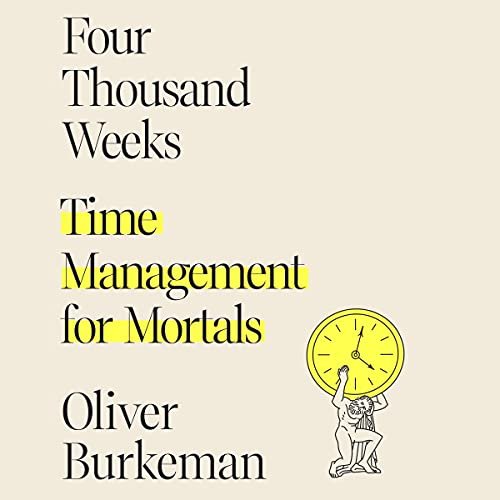
Root to Flourish READS: ‘Four Thousand Weeks - Time Management for Mortals’ by Oliver Burkeman
‘Root to Flourish READS’ recommends ‘Four Thousand Weeks: Time Management for Mortals’ by Oliver Burkeman. In this brilliant book, Burkeman explains that we must make the connection between our daily struggles to “manage time” and the ultimate time management problem, how best to use our 4,000 weeks.

Freedom lies in embracing the finite nature of your life
It’s not enough to intellectually understand that our lives are finite; we must allow that truth to emotionally resonate … and when it does, we must then allow it to affect a change in how we view our day-to-day lives, and in how we actually live those lives.

The Wisdom of Wizards: "What to do with the time that is given us" (Real Life Fantasy)
Gandalf the Grey, from J.R.R. Tolkein’s ‘The Lord of the Rings,’ provides wisdom regarding our use of time. What does. he mean by “so do all who live to see such times. But that is not for them to decide. All we have to decide is what to do with the time that is given us.” This Real Life Fantasy post explores how wishing can create suffering, and how we can respond to the cares of the world.

This is as good as it gets: Accepting - and thriving - in your actual life
There are consequences to living in a future-oriented way: Doing so robs you of your very life. You prevent yourself from being fully present and engaged in the moments of your actual life, which is occurring right now, by always looking forward to the next thing. And, if you cannot be satisfied with this moment as it is, you will not be able to appreciate – or be satisfied by – any other future moments as they are.

Thriving with Autumn Anxiety
Autumn anxiety is a real thing! Neurochemical, biological, and psychological factors all contribute to an increase in anxiety symptoms and low mood in the fall. But, we can thrive and live fully in the fall with increased awareness and intentional practices.

Real Life Fantasy: Enchanted Anxiety - in Ron Weasley's 'Howler'
Like anxiety, the Howler ramps up it’s response to being avoided, escalating to explosions, curses, and insults!

How to Explain Anxiety: The Irony of Anxiety
Anxiety thrives in the paradox, in the irony. The harder we try to get rid of it, the more anxious we feel. It can become a self-fulfilling prophecy, turning our intentions against us, and creating the very thing we are trying to prevent. And, it sneakily makes us believe that we’re in control and that certainty is attainable.

How to Explain Anxiety: Anxiety is a Boggart
Anxiety - like the boggarts of the wizarding world of Harry Potter - shifts its shape to the thing each person fears the very most. Your anxieties are drawn from your individual insecurities and the earlier experiences in your life that build their foundation.

Getting Unstuck - Why New Year's Resolutions Fail
The way real long-term change happens isn’t sexy. And it doesn’t happen just because it’s January 1st, or a Monday.
How to Practice Gratitude - Even, and Most Especially, When Things Suck
Gratitude is not fluff, nor is it toxic positivity. The goal of grateful living is not to pretend that everything’s fine, or to live in a fantasy world populated by puppies and rainbows and unicorns… In fact, gratitude is most especially important at the worst times of our lives.

Overcome Anxiety by Addressing Avoidance
Paradoxically, the intuitive attempt to keep yourself safe and comfortable, the effort to avoid anxiety, only serves to increase the anxiety. Although the immediate act of avoidance may result in a moment of relief, it only serves to exacerbate (make worse) and perpetuate (allow it to continue) your experience of anxiety.

Harness the Power of Your Thoughts to Reduce Anxiety
Your thoughts, what you tell yourself, your self-talk are powerful determinants of anxiety. And the thoughts that create anxiety are often untrue, even irrational.

Why Anxiety Feels Like a Heart Attack: The Neuroscience of Anxiety
The threat center in our brains are turned on by our own thoughts, by threats created in our minds, rather than from legitimate physical threats in our environment. And our body responds as if we were facing a lion, a true threat to our survival.

‘Be Here Now’ to Reduce Anxiety
The present moment is the only moment that you actually have available to you. You spend the actual moments when you are alive anticipating future moments and remembering past moments so you never get to enjoy and thrive in the moments when everything is okay.

Your inner critic – Body Edition, Part 2: Responding to Your Inner Critic
Recognize that you have a choice with regard to whether these thoughts define you … or not. Know that this inner critic, this negative voice, has become an accepted part of your identity, and it will take considerable time, effort, energy, and most especially compassion, to root it out. But, it can be done.

Your Inner Critic: Body Edition, Part 1 - Embody Your Inner Critic
Your negative voice, your inner critic, has been created by your individual circumstances, the things that you have placed emphasis on, the things you feel ashamed about, and the things you think are wrong with you and must be changed. This critic will therefore be a very specific, individualized manifestation of you. The more detailed and specific you can embody it to your own experience, the better you’ll be able to craft personalized, effective responses to it.

Don’t make weight loss the goal. Let it be a side effect of emotional healing.
We work to heal the self-hatred and the self-loathing, and be able to respond to that critical voice … so that weight loss does happen, but it happens as a side effect of the deeper, more emotional work that’s happening … because that’s what is really holding us back.

When will this be OVER? Thriving with uncertainty in this most bizarre of times
Learning to tolerate – and even embrace – uncertainty is a skill that can be learned. And, doing so can change your life.

How NOT to Treat Anxiety: 5 reasons why “STOP IT!” doesn’t work
“STOP IT!” just identifies an unwanted thought and attempts to shove it away while making you feel badly about yourself and ignoring your emotional experience.
Shoving the thought aside and ignoring your feelings simply exacerbates the very things you’re trying to stop.

Sourdough Therapy: 7 Mental Health Lessons to be Learned from Baking Bread
Sourdough baking, should you choose to heed the call, provides an opportunity to reflect, look within, and improve your emotional wellbeing.